Stage lighting power is more than adding the wattage printed on each fixture. It affects dimmer capacity, cable selection, distribution, generator sizing, and operational safety. A small theatre may run twelve 300-watt LED fixtures, while a touring rig can demand several kilowatts across separate circuits. The numbers change quickly.
Stanley McCandless, a foundational stage-lighting educator, wrote, “The art of stage lighting is to make the actors visible, to establish a mood, and to create a three-dimensional stage picture.” His principle still matters when learning how to calculate stage lighting power requirements. Light must serve the performance, but the electrical system must support it reliably. This guide connects creative planning with practical calculations, including fixture wattage, supply voltage, current, power factor, circuit limits, and reasonable reserve capacity. The basic relationship is simple: watts equal volts multiplied by amps. Real installations are less tidy. LED fixtures may draw less power than tungsten units, yet their drivers can affect current behavior. Dimmers and distribution equipment also introduce constraints.
A wattage spreadsheet can still be wrong. It may ignore startup demand, shared circuits, cable distance, or future fixtures. That is why experienced technicians verify manufacturer data and inspect the venue’s electrical infrastructure before energizing the rig. Local electrical rules and a qualified electrician remain essential. Even a modest lighting plot deserves careful checking. Mistakes become expensive. A clear load schedule, measured circuit capacity, and practical headroom create a safer, more dependable stage.
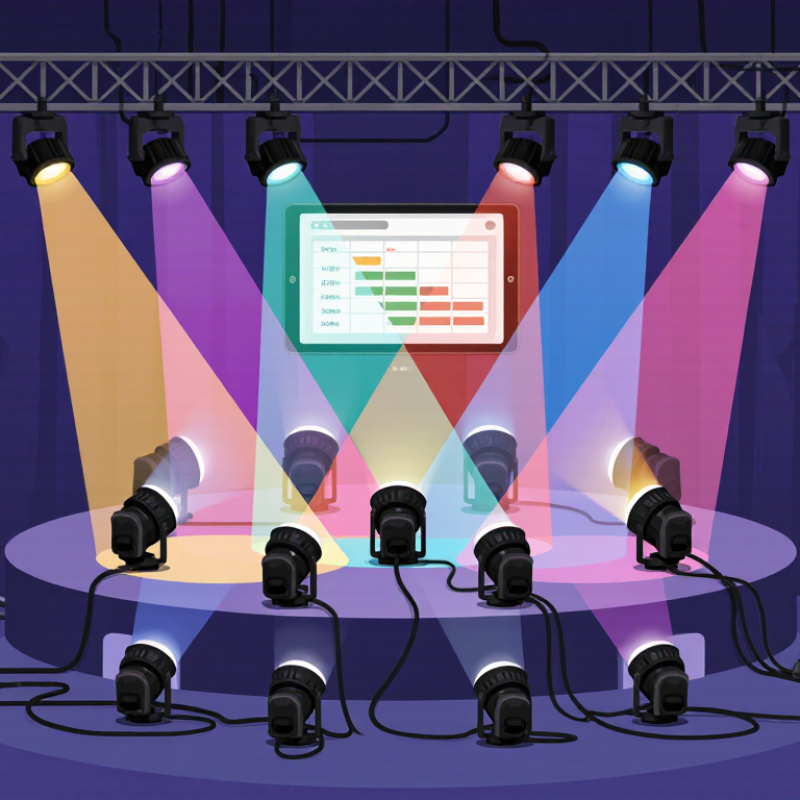
Stage lighting power describes how much electrical energy a fixture uses. Watts measure real power, while volts describe electrical pressure. Amps measure current flow. Power factor shows how efficiently apparent power becomes useful real power.
A 120-volt fixture drawing 10 amps has 1,200 VA of apparent power. With a 0.8 power factor, its real demand is 960 watts. Without the power factor, the estimate looks higher than the fixture’s actual wattage. That difference matters when sizing cables, dimmers, and distribution equipment.
The U.S. Department of Energy’s 2022 Solid-State Lighting R&D Opportunities report identifies higher efficacy and better controls as major energy-saving priorities. Modern LED fixtures often reduce wattage, but lower wattage does not remove inrush current or harmonic concerns.
Read the fixture’s input label carefully. A 600-watt unit may draw different current at 120, 208, or 240 volts. Calculate each circuit from measured or manufacturer-stated input data.
ANSI E1.9, the Entertainment Technology standard for stage lighting documentation, supports clearer electrical information for production planning. A neat formula can still fail in a crowded venue.
Power factor may change with dimming, temperature, and operating mode. I would verify the load with a true-RMS meter whenever the distribution plan is critical. Calculations are useful, but real measurements remain imperfect.
Stage lighting power begins with the fixture’s actual wattage. Modern LED units commonly use 100–300 watts, while conventional tungsten fixtures often consume 750–2,000 watts. That difference changes circuit planning, heat output, and running costs.
A 200-watt LED fixture draws about 1.7 amps on a 120-volt supply. A 1,000-watt conventional fixture draws about 8.3 amps. Use the formula: amps = watts ÷ volts.
Ten 200-watt LED fixtures require about 2,000 watts, or 16.7 amps at 120 volts.
Ten 1,000-watt fixtures require 10,000 watts, exceeding the same circuit many times over.
In practical venue checks, I record each fixture’s rated load, quantity, voltage, and control method. I also leave capacity for dimmer losses, cable heating, and temporary changes. LED drivers may create startup surges, even when their running wattage looks modest. Conventional fixtures create intense heat, so ventilation becomes part of the power plan. A common mistake—and one I have made—is trusting the printed wattage without measuring real operation. A meter can reveal unexpected behavior, especially when fixtures dim, move, or share control equipment. Load calculations should be verified by a qualified electrician and matched to the venue’s protection devices.
Stage lighting power describes how much electrical energy fixtures draw during a performance.
The basic calculation is P = V × I, where P means watts, V means volts, and I means amps.
For example, a 120-volt circuit carrying 10 amps uses 1,200 watts.
To find current, divide power by voltage: I = P ÷ V.
Keep continuous lighting loads below 80% of a circuit’s rated capacity.
A 20-amp circuit should normally carry no more than 16 amps continuously.
If twelve fixtures use 150 watts each, their total demand is 1,800 watts. At 120 volts, that equals 15 amps, leaving little practical margin.
Heat, cable length, control equipment, and other connected devices can change the result.
Check every fixture’s rating plate, not only its advertised light output.
LED fixtures may draw less power, but startup behavior can still deserve attention.
My early estimates were often too optimistic because I ignored small control loads. That mistake is easy to repeat.
Record each fixture, calculate the combined wattage, and divide by the supply voltage. Then apply the 80% limit before assigning circuits.
Local electrical rules may define continuous loads differently, so a qualified electrician should verify the final plan.
Always use correctly rated cables, connectors, protection devices, and distribution equipment for the expected demand.
Stage lighting power means the electrical load drawn by fixtures, control desks, dimmers, and accessories. Circuit sizing starts with voltage multiplied by current. A 120 V/15 A circuit provides 1,800 watts theoretically. For continuous theatrical loads, a safer working limit is about 1,440 watts, using the common 80% guideline. A 230 V/16 A circuit provides 3,680 watts, with roughly 2,944 watts as a practical continuous target. Local electrical rules can require different limits.
Modern LED fixtures reduce power demand, but their nameplate wattage still matters. The U.S. Department of Energy’s solid-state lighting reports show that high-performance LED sources can exceed 150 lumens per watt. That does not mean every stage fixture reaches this level. Optics, cooling, colour mixing, and electronics consume power. Check real input watts, power factor, and startup current. I once sized a small rig from lamp wattage alone. That shortcut was wrong. It ignored control equipment and spare capacity.
Tips: Count every fixture on the circuit. Leave headroom for inrush current and future changes. On 120 V/15 A, ten 120-watt fixtures already use 1,200 watts before accessories. On 230 V/16 A, twelve 200-watt fixtures consume 2,400 watts. Divide total watts by voltage to estimate current, then compare it with the permitted continuous load. The IEC 60364 series and U.S. electrical safety guidance both emphasize installation conditions, cable rating, and protective-device coordination. Numbers help, but site verification remains necessary.
Stage lighting power is the electrical load required to run every part of a show. The fixture count alone is not enough. Add each lamp’s rated wattage, then include dimmers, control gear, distribution equipment, and practical accessories.
For example, twelve 300-watt fixtures require 3,600 watts before other equipment is connected. A small control console, signal devices, and dimmer system may add several hundred watts.
Use this basic calculation: total connected load equals fixture load plus dimmer load plus control load. Convert watts to amps by dividing watts by the supply voltage.
At 230 volts, a 4,600-watt load draws about 20 amps. At 120 volts, the same load draws about 38.3 amps.
Check the equipment nameplates, not memory or estimates. Ratings can differ between operating modes.
Headroom protects the system from uncomfortable surprises. Many production teams allow 20 to 30 percent above the calculated load.
A 5,000-watt estimate may therefore need 6,000 to 6,500 watts of available capacity.
Include startup behavior and future fixture additions when practical. My early calculations often missed control gear. That mistake was small on paper, but noticeable at the distribution point.
Confirm circuit limits with a qualified electrician and follow local electrical requirements. Never assume an apparently empty circuit is safely available.
Watts show real electrical use. Volts show electrical pressure. Amps show current flow. Power factor shows conversion efficiency.
Use this formula: watts = volts × amps × power factor. A 120-volt load at 10 amps and 0.8 power factor uses 960 watts.
Apparent power is volts multiplied by amps. A 120-volt, 10-amp fixture equals 1,200 VA. Its real demand may be 960 watts.
Its theoretical capacity is 1,800 watts. A practical continuous target is about 1,440 watts. Local rules may require a different limit.
It provides 3,680 watts theoretically. About 2,944 watts is a cautious continuous target. Confirm the permitted limit locally.
Not reliably. Count control desks, dimmers, accessories, and startup current. I once ignored spare capacity. That estimate was wrong.
Ten fixtures consume 1,200 watts before accessories. They may fit within a 1,440-watt continuous target. Leave room for startup current.
The same 600-watt fixture can draw different current at 120, 208, or 240 volts. Check input watts, current, and power factor.
No. They often use less power, but inrush current and harmonics can remain. Dimming and temperature may also change power factor.
Yes, especially for crowded venues. A true-RMS meter can reveal unexpected current. Calculations help, but reality is messier.
Stage lighting power describes the electrical demand created by fixtures and supporting equipment. Watts measure actual power, volts describe electrical pressure, and amps indicate current; power factor explains how efficiently equipment uses supplied electricity. LED fixtures commonly consume about 100–300 watts, while conventional fixtures may require 750–2,000 watts each. Understanding these values is essential when learning how to calculate stage lighting power requirements for a safe and reliable setup.
To estimate circuit demand, use P = V × I, then apply the 80% continuous-load rule to leave operating headroom. A 120 V, 15 A circuit provides 1,800 watts in theory, but its recommended continuous load is approximately 1,440 watts. A 230 V, 16 A circuit provides about 3,680 watts, with roughly 2,944 watts recommended for continuous use. Finally, add the wattage of all fixtures, dimmers, control equipment, and accessories, then include extra capacity for startup demand, future additions, and stable show operation.

Dorde Lights